

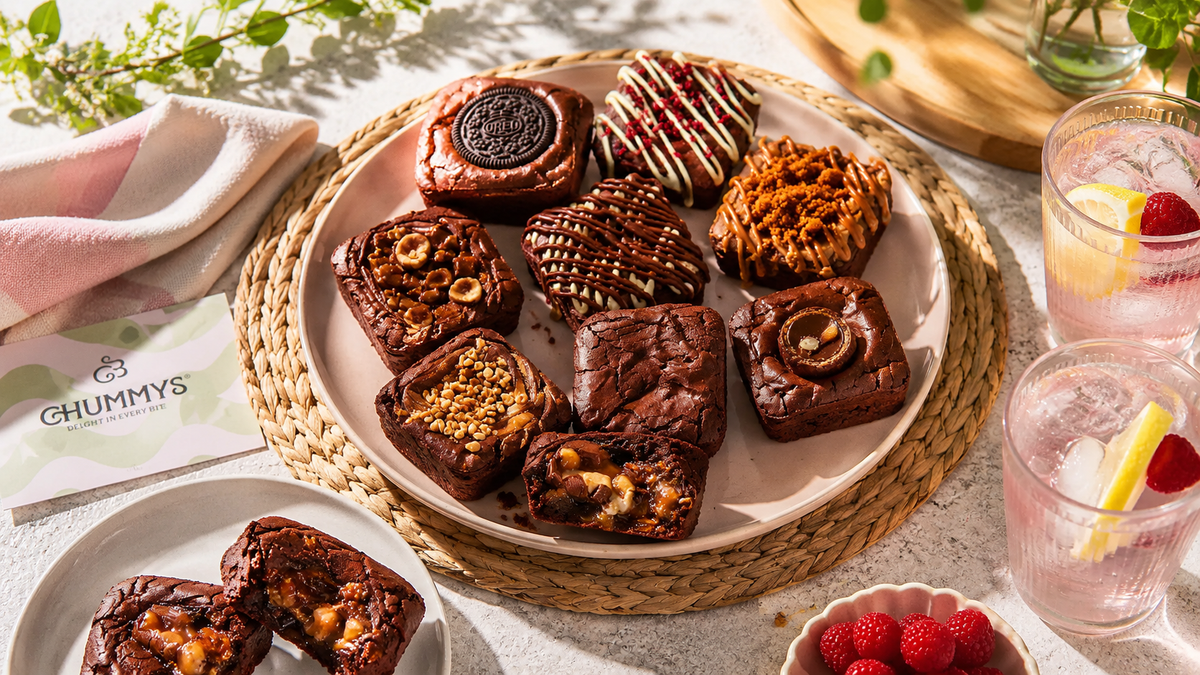
A really good brownie should not need explaining. You know it as soon as you cut into it.
The top has that gentle crackle. The middle is rich and fudgy without feeling raw. The edges have a little bite, but they are not dry. Then the chocolate comes through properly, not just as sweetness, but as depth.
At Chummys, brownies are what we are known for, so we are particular about the details. Not in a fussy way, but in the way that matters when someone is ordering a box for a birthday, a thank-you, a care package, a treat for the office, or simply because they fancy something good.
So, what actually makes a really good brownie? It is not one trick. It is the balance of ingredients, how the brownie is baked, how it is portioned, and how every topping supports the bake underneath.
Here is how we think about it.
A good brownie starts with proper chocolate
If the chocolate is weak, the brownie will be weak. There is no hiding from that.
A brownie does not have many places to hide, so the chocolate needs to do real work. It needs to bring richness, colour, aroma and that deep cocoa flavour that lingers after the first bite. Sugar can make something sweet, but chocolate is what makes it satisfying.
In our original brownie ingredients, we use dark chocolate with a minimum cocoa content of 70 percent, alongside cocoa powder, cocoa mass and fat-reduced cocoa powder. Those ingredients help build the deeper flavour profile we want from a Chummys brownie, rather than relying only on sweetness.
In practice, this is what gives a brownie its proper backbone. Dark chocolate brings intensity. Cocoa powder supports that flavour throughout the crumb. Then sugar, butter and eggs round everything out so the brownie still feels indulgent, not bitter.
That balance is important. Too much sugar and the brownie tastes flat. Too much cocoa without enough fat and moisture, and the texture can become dry. A really good brownie sits in the middle: bold, rich and still soft enough to feel like a treat.
Fudgy centres are about balance, not underbaking
A fudgy brownie is not just an underbaked brownie. That is a common mistake.
Underbaking can leave the middle unstable, heavy and too wet. A proper fudgy centre still has structure. It should hold its shape when lifted, but feel soft and dense when you bite into it.
That comes from the balance between fat, sugar, eggs, flour and chocolate. Butter and chocolate bring richness. Eggs help bind the mixture. Flour gives enough structure to hold everything together. Meanwhile, the baking time controls how much moisture stays in the centre.
At Chummys, our brownies are designed to keep that dense, satisfying texture without tipping into cake. That is why the ingredient balance matters so much. Plain wheat flour is there, but it is not there to turn the brownie into a sponge. It gives enough support for the brownie to hold its shape while still keeping the middle soft.
The difference is easy to spot. A cakey brownie springs back like a small chocolate cake. A fudgy brownie has more weight, more density and more chocolate depth.
Crispy edges are built into the bake
The edges of a brownie are often the best bit. They have more chew, more structure and a slightly deeper baked flavour.
However, not every brownie gives you that. If you bake one large slab and cut it into pieces, only the outside pieces get proper edges. The middle pieces may still taste good, but they do not have the same contrast.
That is one of the reasons we bake our postal brownies as full squares rather than cutting them from one large slab. Our brownie delivery page explains that this gives each brownie crunchy sides and a gooey centre, which is exactly the texture contrast we want.
It is a small detail, but it changes the eating experience. Every brownie gets its own edge. Every brownie has that balance between a slightly firmer outside and a softer middle.
For us, that matters because a brownie box should feel consistent. If someone chooses a mixed brownie box, every piece should feel like a proper brownie in its own right, not just a corner of something bigger.
Butter matters more than people think
Butter does more than add richness. It affects flavour, texture and how the brownie feels once it cools.
In our brownie ingredients, we use unsalted butter with a minimum 82 percent milk fat. That detail matters because higher-fat butter brings richness and helps create the dense, smooth texture people expect from a proper brownie.
Unsalted butter also gives more control. Salt can be added where needed, especially in flavours where caramel, nuts or richer toppings are involved. However, starting with unsalted butter means the base brownie stays balanced.
Butter also helps carry flavour. Chocolate, vanilla and cocoa all taste fuller when the fat balance is right. As a result, the brownie feels rounded rather than dry or sharp.
This is one of those details that does not look exciting on a product page, but you can taste it. A good brownie should feel luxurious without being greasy. Butter helps create that line.
Eggs give structure, shine and softness
Eggs are doing more than holding the mixture together.
They help create the structure that keeps a brownie from collapsing. They also support that slightly glossy top and contribute to the soft, rich middle. In our brownies, we use free range eggs, which sit alongside the chocolate, butter, flour and sugars in the base recipe.
From a baking point of view, eggs are part of the reason brownies feel different from other traybakes. They help emulsify the mixture, which means the fat and liquid combine properly. When that works well, the finished brownie feels smooth and cohesive.
If the balance is wrong, you notice it. Too much egg can make the texture rubbery or cakey. Too little structure can make the brownie too soft to handle. The goal is that middle ground: firm enough to pick up, soft enough to feel indulgent.
Sugar is not just there for sweetness
Sugar plays a bigger role than most people realise.
Yes, it sweetens the brownie. However, it also affects texture, moisture and the top crust. Light brown sugar, for example, brings a deeper flavour and helps with softness because of its natural moisture. Meanwhile, caster sugar supports sweetness and structure more cleanly.
Our brownie ingredients include light brown sugar, alongside the chocolate, cocoa, butter, eggs and flour that build the base.
A good brownie needs sugar, but it should not taste like sugar first. That is the important distinction. The sweetness should support the chocolate, not flatten it.
This is why proper chocolate matters again. If the cocoa profile is strong enough, the sugar can do its job quietly in the background. If the chocolate is weak, the sugar becomes the main event, and the brownie starts to taste one-dimensional.
Vanilla is the quiet ingredient that rounds everything out
Vanilla is not there to make the brownie taste of vanilla. It is there to soften the edges of the chocolate and help everything feel more complete.
Our brownie ingredients include natural vanilla, and in some flavours, Madagascan Bourbon vanilla pods appear within the caramel element.
That kind of detail matters because chocolate can be intense, especially when you are using darker chocolate and cocoa powder. Vanilla brings warmth and balance. It makes the flavour feel smoother and more rounded.
It is the same reason a pinch of salt can improve sweet baking. You may not notice it directly, but you notice when it is missing.
Toppings should add something, not hide the brownie
A topping should never have to rescue the brownie underneath.
We love a loaded brownie, but the base still has to be good. Whether the topping is caramel, biscuit, white chocolate, raspberry, nuts or chocolate drizzle, it should add texture and flavour contrast. It should not cover up a dry middle or a bland chocolate base.
This is especially important in a mixed brownie box. Each flavour needs its own personality, but every brownie still needs to feel like part of the same family. The base should be rich and fudgy. The topping should add the fun.
For example, a biscuit topping brings crunch. Raspberry brings sharpness. Caramel brings softness and sweetness. Nuts bring texture and a toasted note. However, if the brownie below is not right, the topping becomes a distraction.
That is why we always come back to the same point: start with the brownie first.
Small batches help keep brownies consistent
Brownies are simple in theory, but small changes can make a big difference.
Mixing time, oven temperature, cooling time and portioning all affect the final result. If a batch is too large or rushed, it becomes harder to control those details properly.
Our brownie delivery page explains that we bake in small batches to keep our postal brownies fresh and full of flavour. It also notes that we are particular about the details, from ingredients to packaging.
Small-batch baking gives more control. It means we can watch the texture, check the finish and make sure the brownies are packed at the right point. That matters because brownies continue to settle as they cool.
Cutting too soon, packing too warm or rushing the process can affect the finished texture. A good brownie needs care after it comes out of the oven too.
How to spot a really good brownie
If you are trying to judge a brownie, do not just look at the topping. Look at the bake itself.
A really good brownie usually has:
- a rich chocolate smell before you even taste it
- a slightly crackled top
- clean but soft edges
- a centre that looks dense, not airy
- a bite that feels fudgy but not raw
- enough structure to hold its shape
- chocolate flavour that comes through after the sweetness
- toppings that make sense with the base
The best test is simple. Would the brownie still taste good without the topping?
If the answer is yes, the base is doing its job.
Common brownie mistakes at home
Even experienced home bakers can struggle with brownies because the difference between perfect and overbaked can be small.
One common mistake is overmixing once the flour goes in. That can develop too much structure and make the brownie tougher than intended. Another is baking until the centre looks completely firm. By that point, the brownie is often already overdone because it continues to set as it cools.
The tin also matters. A shallow tin bakes differently from a deeper one. A dark tin can bake the edges faster. Meanwhile, cutting brownies before they have cooled can make the texture seem messier than it really is.
If you are baking at home, look for set edges, a slightly soft centre and a surface that has lost its raw shine. Then let the brownies cool properly before judging them.
Patience is annoying. It also helps.
A note on allergens and ingredients
Because brownies contain several key baking ingredients, allergen information matters.
Our original brownie ingredients contain gluten, eggs, milk and soya. The ingredients page also lists plain wheat flour, butter, dark chocolate, cocoa ingredients, natural vanilla and free range eggs as part of the base recipe.
If you are buying brownies as a gift, especially for an office, birthday or family gathering, it is always worth checking dietary needs first. A thoughtful treat should still be a suitable one.
We like being clear about this because food gifting works best when the recipient can actually enjoy what arrives. No guessing. No awkward surprises. Just a proper brownie box, chosen with care.
Why we care so much about the details
A brownie can look simple from the outside. Chocolate, square, delicious. Done.
But behind that are lots of small choices. The chocolate percentage. The cocoa. The butter. The eggs. The balance of flour and sugar. The way it is baked. The way it cools. The decision to bake full squares rather than cut a slab. The toppings. The packaging. The whole thing.
At Chummys, those details matter because our brownies are often part of a bigger moment. Someone is sending a birthday gift, a thank-you, a housewarming treat, a care package, or something sweet to someone far away.
So yes, we care about fudgy centres. We care about crispy edges. We care about proper chocolate.
Because when a brownie is made properly, it does exactly what a good treat should do.
It makes someone pause, take a bite and say, “That is a really good brownie.”


Deel:
Father’s Day Gifts by Dad Type: The Chocolate Lover, Tea Drinker and Last-Minute Legend
Chummys Is Opening Its First Coffee Shop in Droitwich!